My father passed away on August 11, 2026. We spent this last weekend celebrating his life.
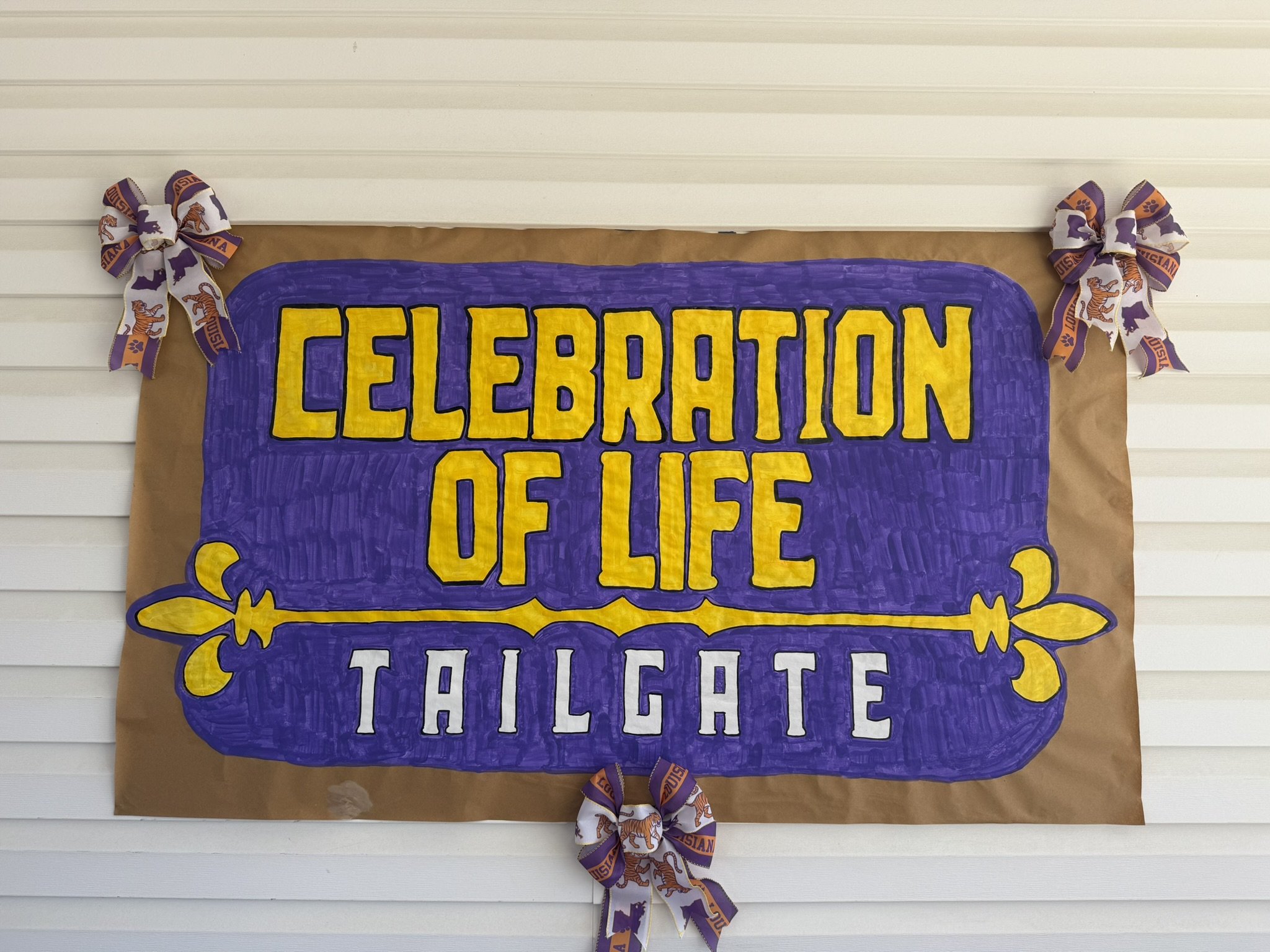
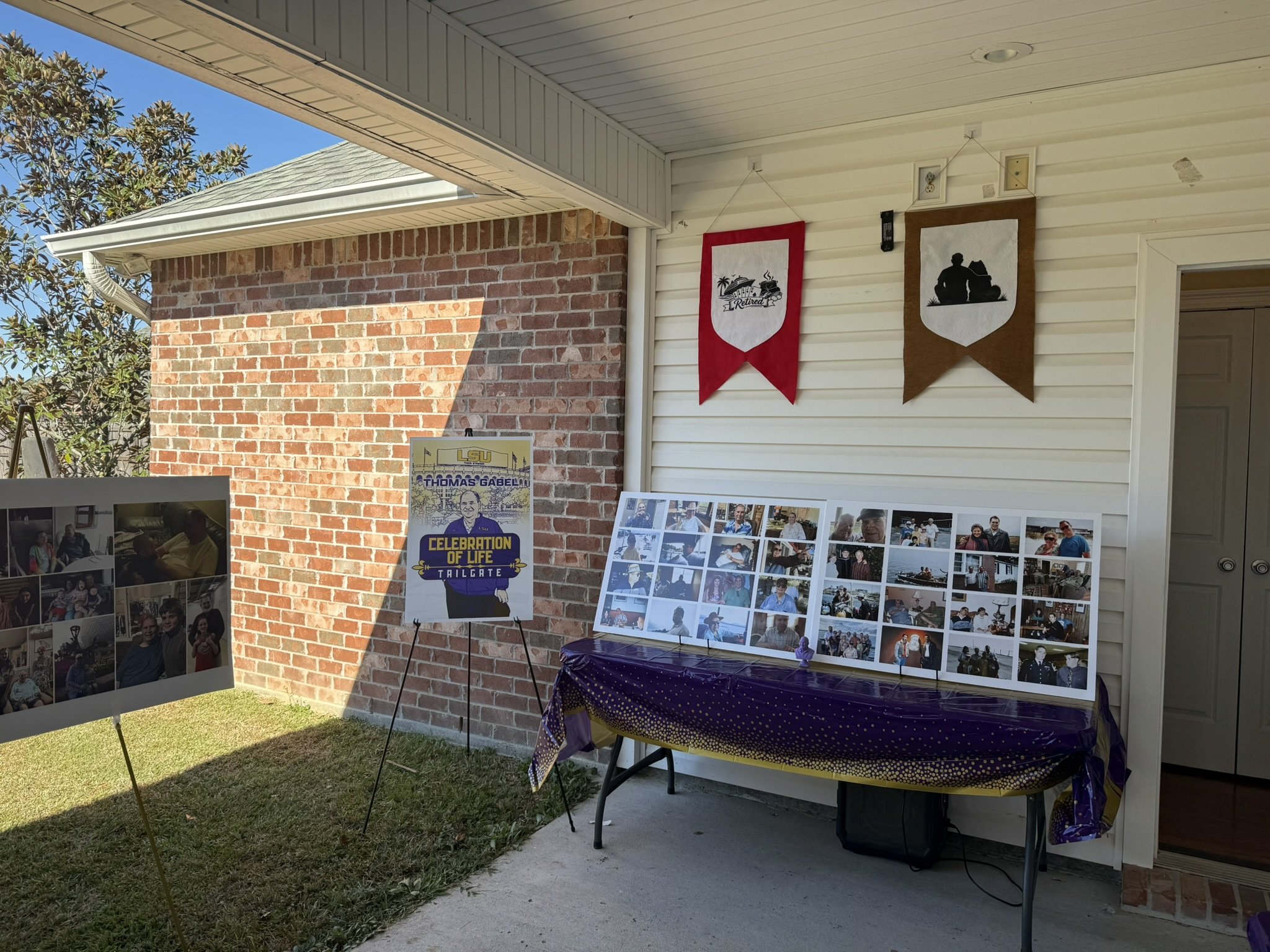
On Saturday, my cousins hosted a Tailgate Celebration of Life. The extended family came together— one cousin hosted at her lovely house, one made beautiful, creative banners honoring his life, another took care of the meat— everyone did something. I took many photos of this.
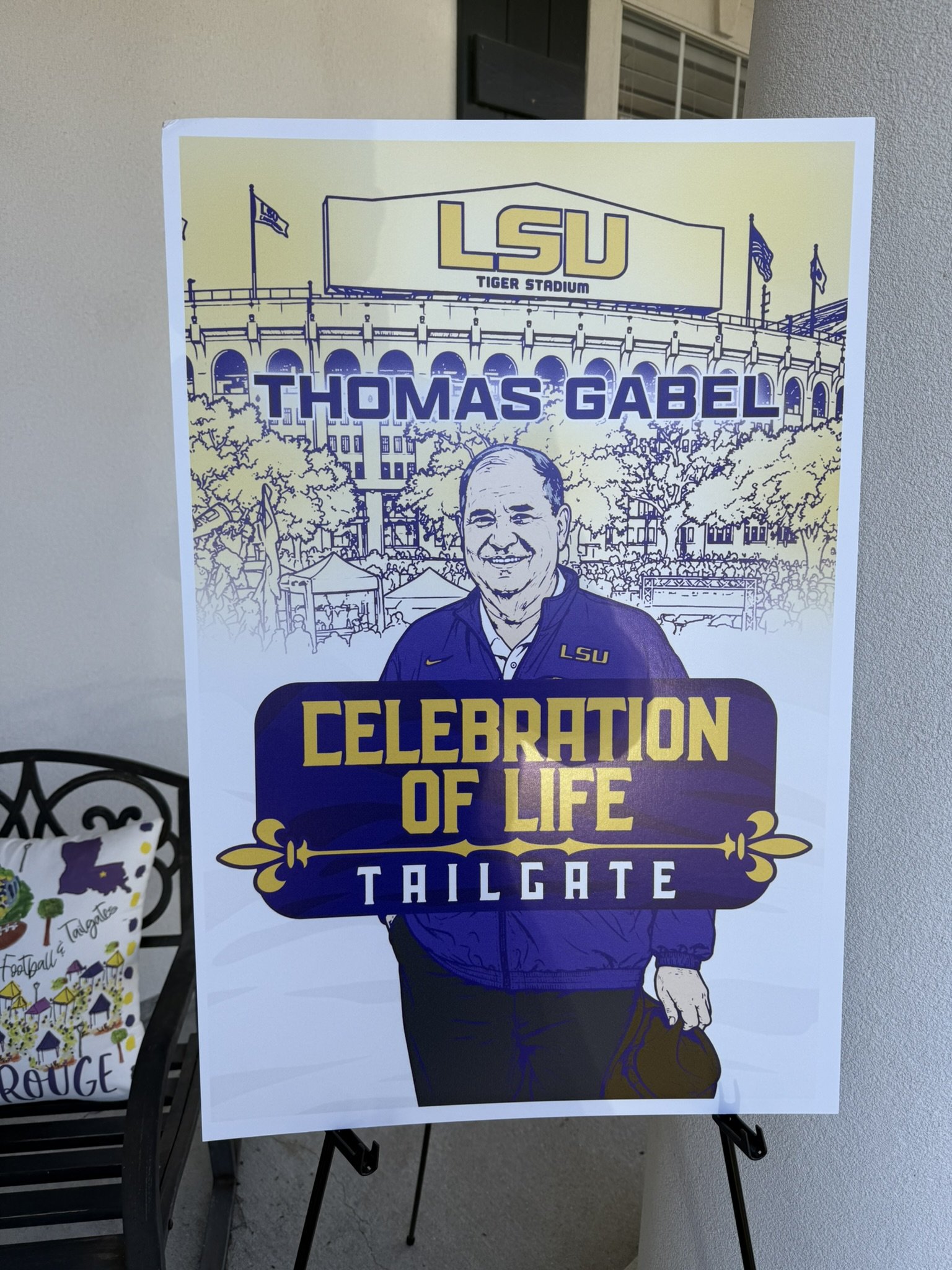
Tom Gabel Celebration of Life Tailgate
On Sunday, we scattered his ashes at Lake Maurepas. My two brothers and I each read part of the poem “Death is Nothing At All” by Henry Scott Holland and taps was played.
Afterwards, the immediate Gabel family, about 35 of us, had memorial dinner in a private room at Middendorf’s Restaurant, Manchac.
I purposefully did not take a single photo on Sunday. But I have a few family members who took some lovely ones.
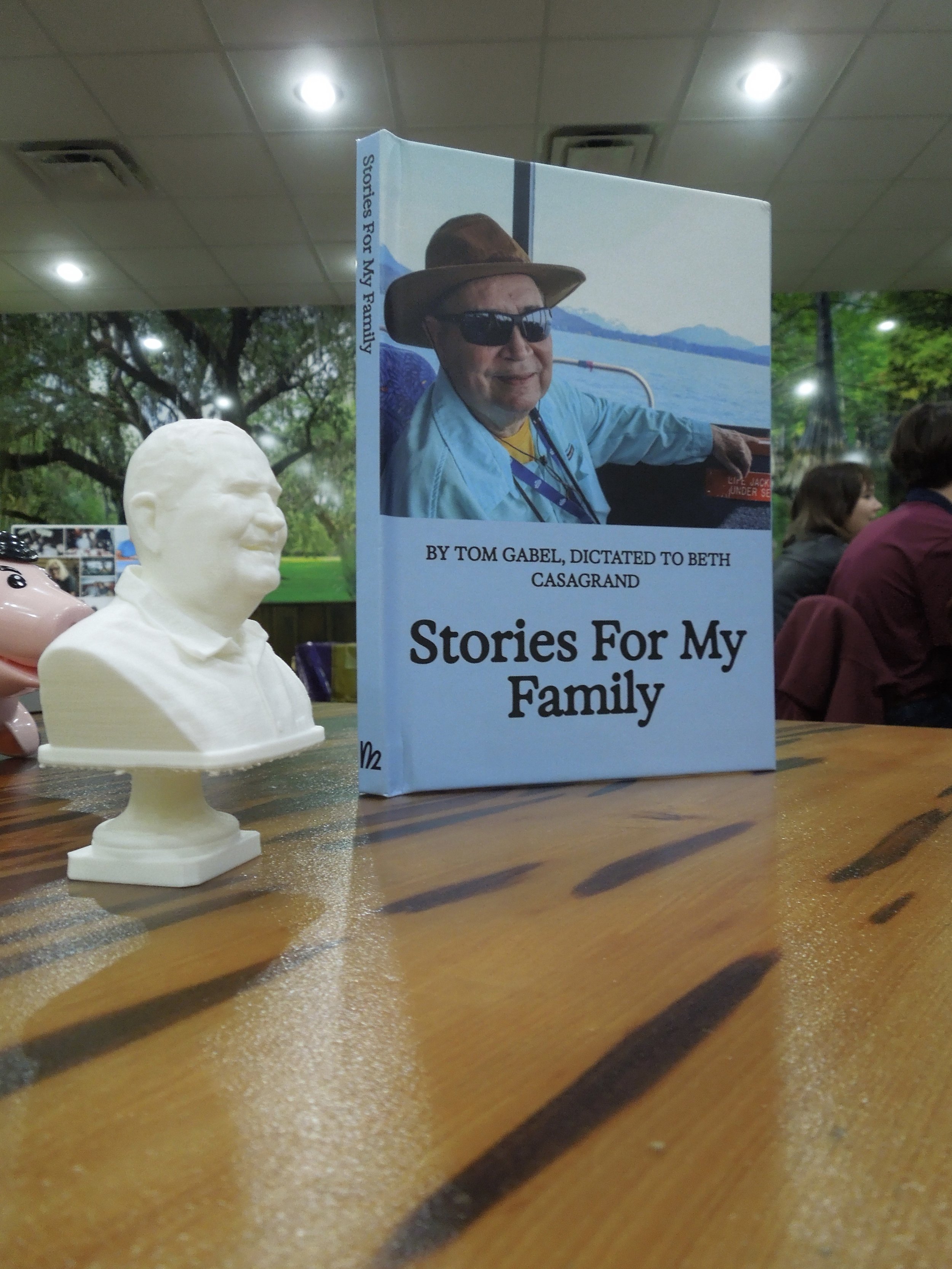
The book I reference in my speech.
3D printed bust created by my son
Here is the speech I made that evening in honor of my father.
Hello everyone. My name is Beth, and Tom Gabel was my father. I want to start off by thanking each and every one of you for being here, for coming together with us to honor him as part of our larger Gabel family.
For Christmas of 2024, I bought him something called “My Life in A Story.” Every week for the year of 2025, he was emailed a question about his life. At the end of the year, those stories would be published together into a book. He wasn’t able to type his answers himself, so I would go over to his house and I would take notes on the computer as he talked.
He was very particular about which stories he wanted to tell. Sometimes I'd ask him a question and he'd tell me he didn't want to talk about that, then launch into whatever completely different story he was thinking about. I took notes as he talked.
If I hadn’t seen him for over a week, I could count on the phone call. “Beth? When are you coming over so we can work on my book?”
At the end of the year, I was left with a pile of notes. I spent a lot of early 2026 turning those notes into his stories.
I hate that he never got to see the finished book. But I'm grateful that he got to read every story, make corrections, and give me his edits along the way.
I treasure that time we spent together. They gave me something I don't think I fully appreciated at the time: the chance to hear my dad tell me who he was, in his own words.
And as I worked through those stories, I started to notice that certain ideas kept coming up. So today, I want to share three lessons I think Dad taught us—not just through the stories he told, but through the way he lived.
LESSON ONE: People are not just one thing.
Most of you know: Tom had two very different careers. He was deeply proud of both of them. He spent twenty years of his life in military service, retiring as a Major. He was the first ever cadet in LSU history to graduate from both Airborne and Ranger School– but the reason that he was first is simply by matter of last name, as his friend Killibrew graduated with him. Unfortunately for Killibrew, G comes before K in the alphabet, so Tom graduated first.
One of the themes that kept popping up was that every single one of us has the capacity for change. For example, he recognized how much anger shaped his younger life, especially in the military— and how he had to find other ways to express himself when he had young children. He realized that he couldn’t be the stable, present father he wanted to be and advance his career in the military. At midlife, he took a big leap: he retired from the military and went to law school.
He wasn’t just any lawyer. He was a public defender– the “if you can’t afford an attorney, one will be appointed by the court”-- well, that appointed person was Tom. He served as a public defender for both the urban area of St. Louis City as well as in rural areas, then finishing his law career as a federal level public defender.
He enjoyed rolling into the courtrooms in cowboy boots, his Louisiana drawl perhaps a little more pronounced than usual. What would happen is that the prosecutor would assume: this is just some dumb hick lawyer, one who doesn’t even get paid very well.
And of course, by the time that they realized that he had actually done his research and that he was a fantastic lawyer, Tom had the jury in the palm of his hand because they all liked him and thought the prosecutor was a pretentious snob.
I think he kind of liked it when people underestimated him, so that he could prove them wrong. It was a little showmanship.
Quick side story that highlights who he is: So, the position of federal public defender, where he finished his career, is considered a prestigious and elite job. But he will tell you that he preferred working as a public defender at the local level. The pay was terrible, it was a bananas workload, but he enjoyed working in the courtroom and feeling like he made a difference in people's lives. People are not prosecuted at a federal level unless there is a mountain of evidence against them, so as a Federal Public Defender, he wasn’t getting anyone out of jail. He rarely even went to court, usually just filed a lot papers and tried to get his clients the best deal possible. Being a Federal Public Defender wasn’t nearly as fun as being a local public defender, according to my dad.
I think his career and his story is a good reminder for all of us: we are not just one thing. We aren’t our job. We aren’t the way we dress. We aren’t even what people assume us to be, for better or worse, based on who they perceive us to be. He wasn’t just an Airborne Ranger, just a Major, just a father, just a husband, just a Public Defender, just a friend– He was all of those things, and more. I think that's something we can all take from his life. We don't have to stay the person we were at 20, or the person other people assume we are. We can change. Each and everyone one of us is capable of so much, if we only dare to go for it.
And that leads up up towards:
LESSON TWO: Friendliness and hospitality are tenets of living a good life.
Here is a litmus test that Dylan and I came up, after our last visit to Navarre beach, of friendliness. It is something we noticed, riding up and down the elevators to get to the pool.
It is: Do you talk to people on elevators?
My dad always did. He was curious about other people. He asked how they were, where they were from. If they had any sort of LSU or military gear represented, triply so– that person wouldn’t be able to leave without having some sort of conversation (probably fairly prolonged) with Tom.
When he passed away, I had a few high school and college friends reach out to tell me how sorry they were, and how they always felt so welcome in our house because of him.
To illustrate: when I was in college, my friend Adam asked if he could spend the night at our house, as he had a flight to catch out of STL early in the morning. Dad and Carol said yes, of course, even though they had only met him once. I wasn’t even there, I was back at college a few hours away.
Afterwards, Adam shared with me that Tom woke him in the morning with the question of, “How do you want your eggs?”. Not, do you want eggs, but the assumption that my dad was going to fix breakfast for him and they were going to eat together. That was nice enough, but after breakfast my dad insisted on driving Adam to the airport. That level of hospitality was the norm– when you visited, he made sure you felt welcome.
Dad loved to host gatherings at their house. He threw many crawfish boils for his colleagues and for family. He and Carol created a home together, one that welcomed people in. I didn’t realize how rare it was to have a stable home, with laughter and food and support, until later in life.
It is easy to be friendly with people who look like you, who talk like you, and who share your same experiences. Dad's hospitality went beyond that. When my daughter El's friend Myles came with us to the Smoky Mountains two years ago, Dad took a liking to him. From then on, he called Myles his "extra grandchild." Myles is a transgender, biracial teenager, and Dad welcomed him into the family without making it complicated. Dad didn't always know all the right words to use in every situation. But he always did his best to make people feel wanted and welcome.
That isn’t to say that some people didn’t rub him the wrong way. He especially disliked hypocrisy. When he was in college at LSU, he was approached by the Campus Crusade for Christ, a religious organization. He started off listening politely to them, but got mad when they started saying how anyone who didn’t know Christ would be sent to Hell. He asked for clarification— what about the people in Africa, who lived in remote villages, who had never heard of Christ? Are they damned? Yes, they told him– if they don’t know Christ, then they are going to burn in Hell. My dad didn’t even need time to mull it over. His response was: “I’d rather burn in hell with the Pygmies from Africa, than spend eternity in heaven with self righteous assholes like you.”
And our final lesson, the reason we are here today, is because of his
LESSON THREE: There isn’t anything better in life than food and family.
The last few years of his life I realized that there was not a single item I could buy my dad that he really wanted. When we asked him what we wanted to do, that was it: he wanted to spend time with his family, and eat good food with his family.
I could go into all of the ways that we marked holidays and special occasions with food– from the Brazilian steakhouse for his birthday every year, to the fried turkeys that we make for Thanksgiving, to stopping here at Middendorf’s every single time he visited Louisana– he loved all of the traditions around food and family.
When I look back at all those stories he told, I realize that the things Dad remembered most weren't necessarily his biggest accomplishments. They were the people, the meals, the trips, the traditions, and the moments when he got to be with the people he loved.
Maybe that's why he loved working on his book. He had a lot of stories to tell, but so many of them came back to the same thing: the people who made his life what it was.
Each and every one of us has finite time on this earth. We don't know exactly when our time will come, but we know it will.
One of the greatest gifts we can give each other is our time. To show up. To sit around a table. To share a meal, tell a story, laugh at an old joke, or strike up a conversation with a stranger in an elevator.
That's what Dad did. And that's what he wanted most from us.
We were planning a pig roast for his 75th birthday. He didn't get to celebrate it with us, but in the weeks leading up to it, he got to call people, reconnect with old friends, and hear from family members he hadn't talked to in a while. You gave him so much joy, even though the party never happened.
And today, here we are. His family and friends, spending time together, sharing stories, and preparing to share good food. I can't think of a better way to honor him.
Dad always said Johnny Cash was his favorite poet, so I scoured his work for a quote that felt right. I'd like to end with these words:
"Life and love go on, let the music play."
So let's raise a glass to Tom Gabel. To a life of service, a heart full of love, a life of open doors and full tables, and a life filled with the people he loved.
To Dad.
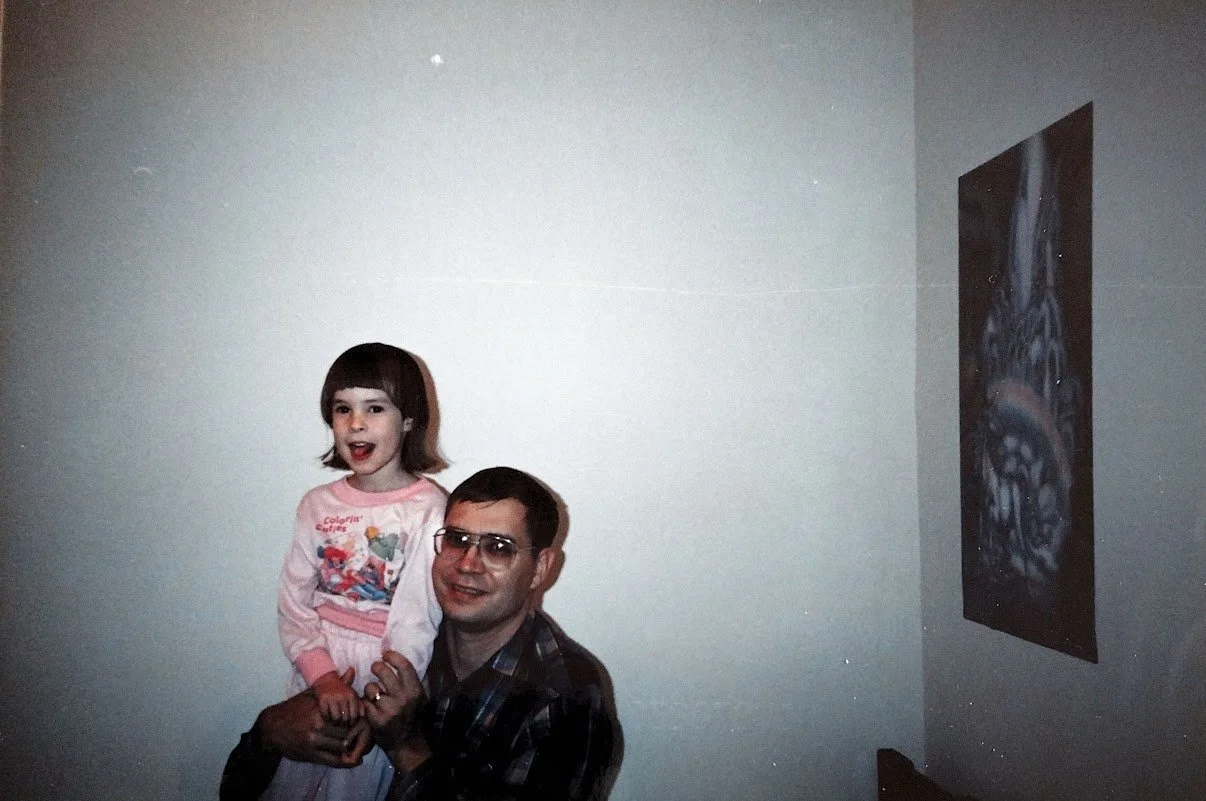
I love you, Dad.
